
Stress-Free Moving: Your First Night Tips
Moving Tips, Stress-free Moving, First Night Home, Moving Organization, Cost-effective Relocation, Family Moving Experience
The First Night
Your first night in a new home sets the tone—discover how a smooth move creates peace instead of stress.
When the Door Clicks Shut Behind You
There is a particular sound the front door makes when you close it on the first night home. It is heavier than usual, echoing off unfamiliar walls and half-empty rooms. For a moment, the silence after that click can feel terrifying—an ocean of cardboard, a maze of furniture, the weight of a new chapter pressing down on your shoulders. Or, if you have prepared with intention, that same silence can feel like a deep, steady breath: calm, hopeful, filled with possibility rather than panic. The difference between those two realities is not luck. It is moving planning.
Moving is one of life’s most emotional transitions. You are not just transporting objects; you are carrying memories, routines, and pieces of your identity from one space to another. Without a plan, the process can quickly unravel into chaos, arguments, unexpected bills, and sleepless, anxious nights. With a thoughtful approach to Moving Organization, Cost-effective Relocation, and realistic Moving Tips, that same journey becomes something else entirely: a powerful reset, a chance to rewrite how you live and what you prioritize, starting from that very first night in your new home.
Why Planning Your Move Is an Emotional Lifeline
People often treat moving like a logistical puzzle—boxes, trucks, addresses, utilities. But beneath the tape and labels is something more fragile: your sense of safety. On moving day, your familiar world is disassembled. Drawers are emptied, closets exposed, favorite mugs wrapped and hidden. The life you know disappears into boxes, and for a while, you live in between worlds. This is why Stress-free Moving is not a luxury; it is a form of emotional protection, especially on that first night when you are most vulnerable to overwhelm and regret.
Detailed moving planning is the rope you hold onto while you cross this emotional bridge. A plan tells you what happens next when your mind is too tired to decide. It tells your children where their favorite toy is when they are crying in a strange bedroom. It tells your future self, standing in the dark kitchen at midnight, exactly which box holds the kettle and the tea. Planning is not about perfection; it is about kindness—to yourself, to your family, and to the version of you who will stand in that new space on the first night and desperately need things to feel even a little bit okay.
📌 Key Takeaway: Moving planning is not just about logistics; it is about protecting your emotional energy so your first night home feels like a beginning, not a breakdown.
The First Night Home: Two Very Different Stories
Imagine two families, both arriving at their new homes on the same rainy Saturday evening. Their keys turn in the lock at almost the same time. But what happens next could not be more different. These contrasting Family Moving Experience stories reveal exactly why organization, cost control, and efficiency matter so deeply on moving day—and especially on the first night home.
Family One: The Night of Frustration
For the first family, the day has been a blur of last-minute decisions. They started packing only a week before. Boxes are a chaotic mix of kitchen items, bathroom supplies, and random toys. Nothing is labeled clearly. The movers arrived late, the truck was too small, and an extra trip cost more than they had budgeted. By the time they reach the new house, everyone is exhausted, hungry, and irritable. Rain soaks through the open boxes as they rush them inside. The children are crying. The dog is barking. The lights flicker because they forgot to confirm the utility transfer date. They cannot find the bedding, the toothbrushes, or the pajamas. Pizza arrives cold and late because no one thought to check which places deliver to the new address.
That first night home is spent on bare mattresses, under borrowed coats, with phones on low battery and no charger in sight. Tempers flare. Someone breaks down in tears. In the dark, surrounded by half-open boxes and regret, the new home feels less like a dream and more like a mistake. This is what moving without planning can cost you—not just money, but peace, connection, and the fragile excitement of a new beginning.
Family Two: The Night of Quiet Relief
Now picture the second family. Their day is still long—moving always is—but it unfolds with a sense of order. Weeks before, they created a simple moving timeline. They followed practical Moving Tips to declutter, pack by room, and label every box with clear categories and priorities. They set aside a “First Night Home” kit: bedding, pajamas, toiletries, a small toolkit, snacks, chargers, and a change of clothes for each family member. They confirmed the moving company’s arrival time, double-checked their Cost-effective Relocation quote, and arranged for utilities to be active a day before they moved in. They even saved a little extra in their budget for a special first-night takeaway dinner.
When they step into the new house, they know exactly where the “First Night” boxes are because they were loaded last and labeled boldly. Within an hour, beds are assembled, sheets are spread, and a familiar blanket is draped over the sofa. The kids find their favorite stuffed animals in the clearly marked “Kids – First Night” box. The family sits together on the living room floor, eating warm food, laughing about the day’s small mishaps instead of drowning in them. Outside, the rain still falls. Inside, there is a soft glow of lamps, a sense of safety, and the quiet thrill of a new chapter beginning well. This is Stress-free Moving in action—not because nothing went wrong, but because planning held everything together when it could have fallen apart.
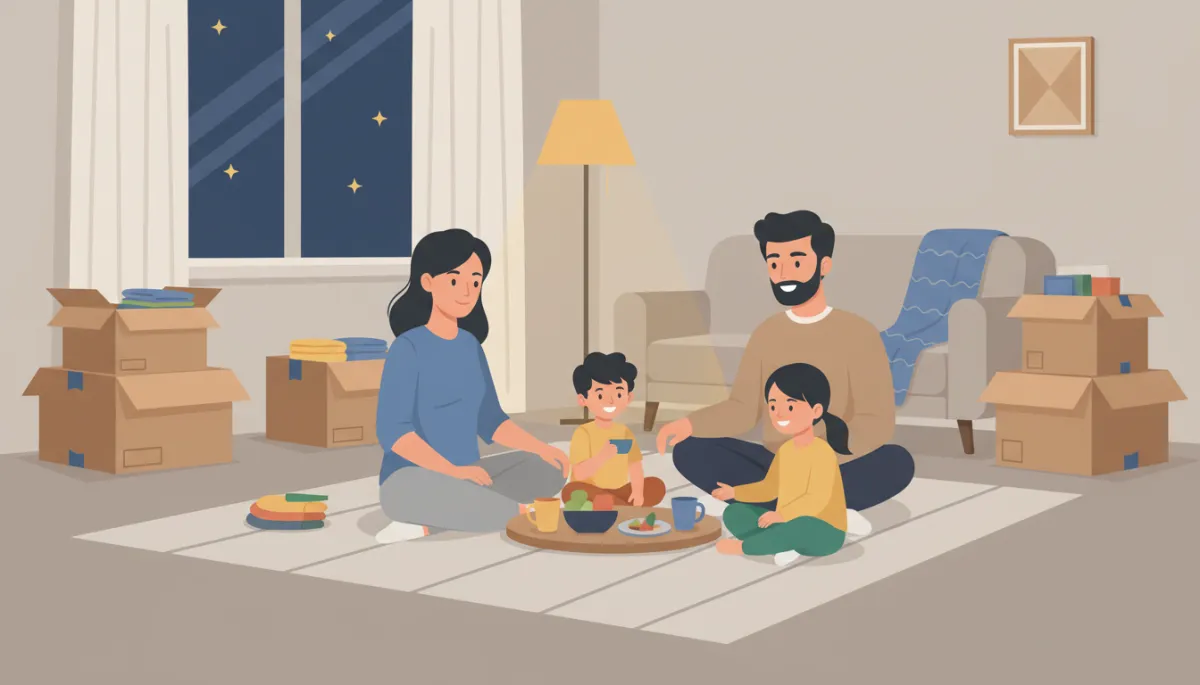
A planned first night home turns cardboard chaos into a calm, shared memory.
The Pillars of a Peaceful First Night: Organization, Cost Control, Efficiency, and Stress Reduction
1. Organization: Turning Overwhelm into Order
Organization is the heartbeat of any successful move. Without it, even the most enthusiastic start can dissolve into confusion. With it, you create a structure that carries you from the first packed box to the first peaceful night home. Moving Organization is not about color-coded perfection; it is about clarity. You want to know what you own, where it is going, and what you need immediately versus later. This clarity is what keeps you from tearing through ten boxes at midnight, searching for a single toothbrush while tears sting your eyes from exhaustion.
Create a master moving list. Write down every category of items and every major task—from canceling old utilities to setting up mail forwarding. Crossing items off this list will give you momentum and a sense of control during a time when so much feels uncertain.
Pack by room, not by random convenience. Each box should belong clearly to one space: “Kitchen,” “Bathroom,” “Bedroom 1.” This simple discipline dramatically speeds up unpacking and reduces decision fatigue on the first night home.
Label with purpose. Go beyond “Kitchen.” Add short, emotional lifesavers like “Kitchen – Coffee/Tea,” “Bathroom – First Night Essentials,” “Kids’ Room – Comfort Items.” These labels are like tiny future hugs for the tired version of you who will be grateful you thought ahead.
When your move is organized, your new home greets you differently. Instead of a wall of anonymous cardboard, you see a map of your life, clearly marked and ready for the next step. This is the foundation of Stress-free Moving and the reason your first night can feel secure instead of scattered.
2. Cost Control: Protecting Your Budget and Your Peace of Mind
Money is one of the loudest stress amplifiers during a move. Every unexpected fee, every extra trip with the truck, every last-minute purchase at the hardware store chips away at your sense of security. Cost-effective Relocation is not just about saving dollars; it is about preserving emotional stability. When you know what you can afford and how you will spend it, the move feels grounded instead of risky. You are not just throwing your belongings into a truck; you are guiding your finances through a fragile transition with intention and care.
Build a realistic moving budget. Include obvious costs (movers, truck, packing materials) and hidden ones (cleaning supplies, takeout meals, pet boarding, childcare, parking permits). When those expenses appear, they will not feel like ambushes; they will feel like part of a plan you already accepted.
Compare quotes and ask hard questions. A cheaper moving company is not always better if it means delays, damaged items, or surprise fees. Ask for written estimates, insurance details, and clear timelines. Cost-effective does not mean “cheapest at any cost”; it means “fair, transparent, and aligned with your needs.”
Plan for the first-night expenses. Budget for a simple but comforting first-night meal, maybe a favorite dessert, and any small items you want to buy fresh—like new candles, a plant, or a cozy throw. These are not frivolous extras; they are emotional anchors that help your new space feel like home more quickly.
When you control your costs, you also control the narrative of your move. Instead of telling the story of “That move that drained us financially and emotionally,” you create a story of “That move we handled with clarity and strength.” On the first night home, as you lie down in your new bedroom, you will not be replaying numbers anxiously in your mind. You will be able to rest, knowing the financial side of this transition is as cared for as the emotional one.
3. Efficiency: Respecting Your Time, Energy, and Sanity
Efficiency is not about rushing; it is about moving with purpose. A move that drags on without structure can erode your patience, your relationships, and your physical health. The more scattered the process, the more likely you are to snap at loved ones, misplace important documents, or push your body beyond what is safe. By planning for efficiency, you protect not only your schedule but your emotional bandwidth. You give yourself the gift of arriving at your first night home with something left in the tank instead of collapsing into it empty and resentful.
Create a moving timeline. Break the process into weeks and days: decluttering, packing non-essentials, packing essentials, confirming logistics, and cleaning. When tasks are spread out, each day becomes manageable instead of overwhelming, and your final moving day is less of a frantic sprint and more of a strong finish.
Delegate with intention. If friends or family offer to help, assign them specific roles: “You handle kitchen packing,” “You watch the kids,” “You keep track of the inventory list.” Clear roles turn well-meaning chaos into coordinated support, lightening your load without creating more confusion.
Stage your move. Place boxes near the door by order of priority, with “First Night Home” items loaded last so they come off the truck first. This simple act of sequencing can shave hours off your unpacking time and make the first evening dramatically smoother.
Efficiency honors your humanity. It acknowledges that you are not a machine built to lift, decide, and organize endlessly. You are a person with limits, emotions, and relationships that need care during this transition. When your move is efficient, your first night home becomes an exhale, not a collapse. You have time to notice the way the light falls in your new living room, to listen to the quiet, to feel gratitude instead of only exhaustion.
4. Stress Reduction: Creating Calm in the Middle of Change
No move is completely stress-free. You are uprooting your life; some nerves are natural. But there is a vast difference between healthy nerves and crushing anxiety. Stress-free Moving is really about stress-managed moving—designing your process so that tension does not spiral out of control, especially on that emotionally charged first night. Stress reduction is not selfish; it is an act of care for everyone who shares this transition with you, whether that is a partner, children, roommates, or even a beloved pet who feels every shift in your tone of voice.
Protect your sleep before the move. In the week leading up to moving day, prioritize rest. The more exhausted you are going in, the more fragile you will feel emotionally. Being well-rested is one of the most underrated Moving Tips for emotional resilience.
Plan emotional breaks into the day. Schedule short pauses to drink water, eat something nourishing, or simply step outside for a deep breath. These moments of stillness keep your nervous system from tipping into overload, so when you finally arrive at your new home, you have the capacity to feel joy instead of just relief that it is over.
Create a comfort ritual for the first night. Maybe it is lighting a candle that smells like your old home, playing a favorite playlist, or making hot chocolate. These small rituals signal to your body and mind: “We are safe. We are home.” They transform a bare, echoing space into a place that holds you gently on that first night.
When stress is managed, your first night home becomes more than just a logistical milestone. It becomes a memory you will carry: the night you sat among boxes and felt not panic, but possibility; the night you looked at your family, your partner, or even just your own reflection and thought, “We did it. We made it here. And we are okay.”
Designing Your First Night Home: A Practical, Heart-centered Guide
The First Night Home is not an afterthought; it is the emotional climax of your move. Planning for it is one of the most powerful ways to turn moving from a chaotic event into a meaningful transition. Here is how to design that night with intention, blending practical Moving Tips with deep emotional awareness so your experience feels both organized and profoundly human.
Build a “First Night” Box (or Two) with Love, Not Just Logic
Your “First Night” box is more than a container; it is a care package you send to your future self. Pack it as if you are preparing for someone you love deeply—because you are. Imagine arriving tired, emotional, and overwhelmed. What would make that version of you feel safe and seen? That is what belongs in this box. Label it clearly: “FIRST NIGHT – OPEN IMMEDIATELY.” Make sure it travels with you, not buried at the back of a truck.
Essentials for comfort: bedding, pillows, pajamas, toiletries, towels, toilet paper, basic cleaning wipes, phone chargers, a change of clothes for the next day.
Essentials for calm: a favorite book, a journal, a comforting snack, herbal tea, a cozy blanket, a small lamp or string lights for soft, warm lighting instead of harsh overhead bulbs.
Essentials for connection: a game or deck of cards, a family photo to place on a shelf, a small toy for each child, or a special treat you all share only on meaningful nights.
This box is the beating heart of your first night. It carries not just what you need to survive, but what you need to feel human, loved, and grounded during one of life’s most disorienting experiences. This is Moving Organization at its most compassionate form.
Choose One Room to “Finish” First—Even If It’s Only 80%
On moving day, you cannot do everything. Accepting that is an act of self-respect. Instead of trying to unpack the entire house, choose one room to make as functional and comforting as possible before you go to sleep. For many, this is the bedroom or the living room. For families with young children, it might be the kids’ bedroom, so they have a safe nest in the middle of change. The goal is not perfection; it is relief—a place where your nervous system can rest from the visual noise of boxes and scattered belongings.
If you choose the bedroom, focus on making the bed, setting up a soft lamp, and clearing a path to the bathroom. A made bed in a new home feels like a promise: “You belong here now.”
If you choose the living room, arrange a few seats, lay out a blanket, and stack a few boxes as a temporary coffee table. This becomes the stage for your first shared meal, your first conversation about what you love already, and what you cannot wait to change.
By intentionally “finishing” one space, you create an island of calm in a sea of transition. This is a profound act of Stress-free Moving: giving yourself somewhere to land emotionally, not just physically, on that first night home.
Plan Your First Meal Like a Celebration, Not a Scramble
Food is emotion. On your first night in a new home, what you eat and how you share it can either amplify your stress or soothe it. Instead of leaving dinner to chance—hoping something will be open, hoping you will have the energy to cook—plan it as part of your move. This is one of the simplest yet most powerful Moving Tips for emotional well-being.
Decide in advance whether you will order takeout, heat up a pre-made meal, or pack a picnic-style dinner. Make sure you have plates, cups, and utensils in your “First Night” box, even if they are disposable for that evening only.
Choose something familiar and comforting, not experimental. This is not the night to try a brand-new cuisine. Your nervous system craves familiarity; give it that gift through flavors and aromas that say, “We know this. We are okay.”
If you are moving with family, invite everyone to share one thing they are grateful for as you eat. It might feel small or even awkward at first, but these conversations gently shift the focus from what you left behind to what you are building together now.
A planned, simple meal can turn your first night from a frantic search for food into a quiet, grounding moment of connection. It is a powerful symbol: you are not just surviving this move; you are nourishing yourselves through it.
The Emotional Arc of a Family Moving Experience
Whether you are moving alone or with loved ones, every move has an emotional arc. There is the anticipation, the doubt, the chaos, the exhaustion, and finally, the fragile hope of settling in. For families, especially with children, this arc is magnified. Kids may not fully understand why they are leaving their old room, their school, or their neighborhood. They feel the tension in the air, the late-night packing sessions, the whispered conversations about money and timing. How you plan your move—your organization, your cost control, your efficiency, your strategies for stress reduction—shapes not only the logistics but the emotional memory your family carries of this time.
Picture a child lying in a new bedroom on the first night home. The walls are unfamiliar, the sounds outside different. Maybe they miss the creak of the old house, the way the light used to fall on their favorite poster. If the move was chaotic, that child may also be carrying images of parents arguing over lost items, of panicked searches for essentials, of tearful goodbyes rushed by poor planning. But if the move was thoughtful, that same child might remember choosing which toys went into their special “First Night” box, being part of labeling their own room, or helping place a beloved stuffed animal on a new shelf before bedtime. They might remember laughter over pizza on the floor, a parent reading a favorite story under a new ceiling, the soft assurance that “We are together. That is what matters most.”
💡 Pro Tip: Involve children in simple moving organization tasks—labeling their boxes, choosing their first-night pajamas, or packing a “treasure bag” of special items. It gives them a sense of control and turns fear into participation.
The way you plan and execute your move becomes part of your family’s shared story. Years from now, you might say, “Remember the first night in this house?” What do you want that memory to feel like? Hectic, bitter, and draining—or tender, proud, and even quietly magical? Every list you make, every budget you draft, every label you place on a box is a small vote for the story you want to tell later.
Moving Tips That Turn the First Night into a New Beginning
To bring all of this together—organization, cost control, efficiency, and stress reduction—here are practical, emotionally grounded Moving Tips to carry with you as you prepare for your own First Night Home. These are not about achieving a flawless move; they are about building a move that holds you gently when things get hard, a move that honors both your practical needs and your emotional reality.
Start earlier than you think you need to. Procrastination is one of the biggest enemies of Stress-free Moving. Even packing one box a day several weeks in advance can dramatically reduce last-minute chaos and the emotional weight of feeling behind.
Declutter with compassion, not cruelty. Letting go of items can be emotionally charged. Give yourself time to say goodbye to certain objects, especially sentimental ones. Donate, recycle, or gift what no longer serves your life. Every item you release is one less thing to pack, move, and unpack—and one more step toward a lighter, more intentional new chapter.
Keep important documents and valuables with you. Passports, birth certificates, financial records, and small treasured items should travel in a bag you personally carry. This is about more than safety; it is about knowing that, no matter how hectic the day becomes, the core of your life is literally in your hands.
Confirm everything twice. Call the moving company, utility providers, and landlord or real estate agent in the days before your move. Double-check dates, times, and access information. Every confirmation is a thread of stability woven into your moving day, preventing last-minute shocks that can unravel your calm.
Set a firm “no more packing” time on moving day. Decide in advance that, for example, by 10 p.m., you will stop working, no matter what. This boundary protects your body and mind. Even if some boxes are not perfectly arranged, honoring that limit tells your nervous system: “We matter more than the to-do list.”
These tips are not abstract advice; they are small, concrete ways to create a move that respects your whole self. When combined with thoughtful Moving Organization, mindful Cost-effective Relocation strategies, and deliberate efforts toward efficiency and stress reduction, they transform your first night home into something rare in the world of moving: a moment of genuine peace.
The-first-night-moving: A Quiet Promise to Yourself
The phrase “the-first-night-moving” might sound like a technical label, a URL slug on a website. But behind it lies something deeply human: the fragile, unforgettable moment when you cross the threshold into a new life. The door closes. The echoes settle. You look around at the boxes, the bare walls, the unfamiliar shadows, and you realize: this is it. This is where the next chapter begins. How that moment feels—whether it tightens your chest with dread or softens your shoulders with relief—is profoundly shaped by what you do long before that night arrives.
When you commit to moving planning—when you prioritize organization, protect your budget through Cost-effective Relocation, design efficiency into your days, and fiercely guard your emotional well-being—you are not just planning a move. You are making a quiet promise to yourself: “I will not abandon my needs in the name of productivity. I will not let this transition crush my spirit. I will arrive in my new home with enough of myself intact to enjoy it.” That promise is the true heart of Stress-free Moving.
Your First Night Can Be Different
You may have lived through chaotic moves before—the frantic packing at 2 a.m., the lost keys, the aching back, the fights born from exhaustion and fear. Those memories can make you believe that moving is simply destined to be miserable. But it does not have to be that way. This time can be different. This time, your first night home can feel like a gentle landing instead of a crash. You can step into your new space, surrounded by boxes, and still feel a sense of quiet triumph: “I did this. I honored myself through this. I am home.”
Start with one decision today. Maybe it is creating a moving checklist. Maybe it is drafting a simple budget. Maybe it is setting aside a box labeled “First Night Home” and placing the first comforting item inside. Each small step is a thread in the safety net that will catch you on that first night, when your body is tired and your heart is tender. Each act of preparation is a message to your future self: “I see you. I am taking care of you, even now.”
A Final Vision for Your First Night
Close your eyes for a moment and imagine it: the-first-night-moving in your own life. The last box comes off the truck. The door shuts with that familiar heavy sound—but this time, it does not scare you. In the living room, a lamp you packed carefully glows softly. Your “First Night” box sits open, already offering what you need: a clean towel, your favorite mug, a book you love. Maybe someone you care about is there with you, or maybe it is just you and the quiet hum of a new refrigerator in a new kitchen. You breathe in. The air smells different, but not unfriendly. You know where your pajamas are. You know where your toothbrush is. You know where you will sleep. You know that tomorrow, and the next day, and the next, you will slowly turn this space into a home.
This is the power of planning. This is the gift of organization, of thoughtful cost control, of intentional efficiency, of deliberate stress reduction. It is not about creating a perfect move. It is about creating a move that holds you, that honors the depth of what it means to uproot your life and plant it somewhere new. Your first night home can be a moment of quiet, powerful joy—a soft, steady beginning to everything that comes next. You deserve that. And with the right planning, you can create it.